In this edition of the newsletter we interview Ulf Bergström, marine ecologist and research at the Swedish University of Agricultural Sciences. He tells us about his work on stickleback regime shifts along the Swedish coast of the Baltic Sea.
Acceptto see the video.
Stickleback takeover
Contact: Johan Eklöf or Ulf Bergström
A new scientific study shows that large numbers of three-spined stickleback have gradually taken over greater areas of the Baltic Sea’s coastal ecosystem. Stickleback is a small prey fish common in aquatic food webs across temperate European waters. These changing patterns contribute to local ecosystem ‘regime shifts’, where young-of-the-year pike and perch decline in individual bays. These shifts are gradually spreading like a wave from the outer archipelago to the mainland coast.
The stickleback explosion
“In the Baltic Sea, the number of stickleback has increased dramatically since the 1990s”, says Ulf Bergström, the researcher who first documented the increase. Eutrophication, climate change and fewer predators are at least part of the explanation for the sharp rise in stickleback. However, research is underway to further investigate the causes.
At the same time, the recruitment of pike and perch – two large predatory fish that eat stickleback – has decreased in the outer archipelagos and open coastal stretches, where the sticklebacks often reside during spring and summer. Previous studies have shown that the stickleback can eat the eggs and larvae of pike and perch, but it has not been known to what extent this has actually affected their reproduction on a larger scale.
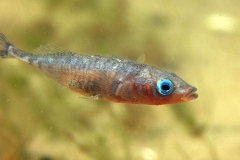
A male stickleback (Gasterosteus aculeatus) during spawning time. Photo: Joakim Hansen/Azote
The researchers now believe that the scale of the stickleback wave reveals an urgent need for increased monitoring so that we can detect and counteract this type of change in the future.
Better monitoring
“The problem has previously gone under the radar or been judged to be very local, as existing monitoring programs have not focused on small fish and nor made any spatial analyses”, says Ulf Bergström.
A better understanding is needed of the connections between the open sea and the coast, where the stickleback’s yearly migrations connect the two systems. This knowledge is already building through a new project called “The stickleback wave”, funded by the Swedish Research Council Formas.
Regime shifts are large, sudden and long-lasting changes in the structure and function of ecosystems, often triggered by human pressures on the environment.
Link to the original article
This article is part of the WWF Baltic Newsletter – December 2020