
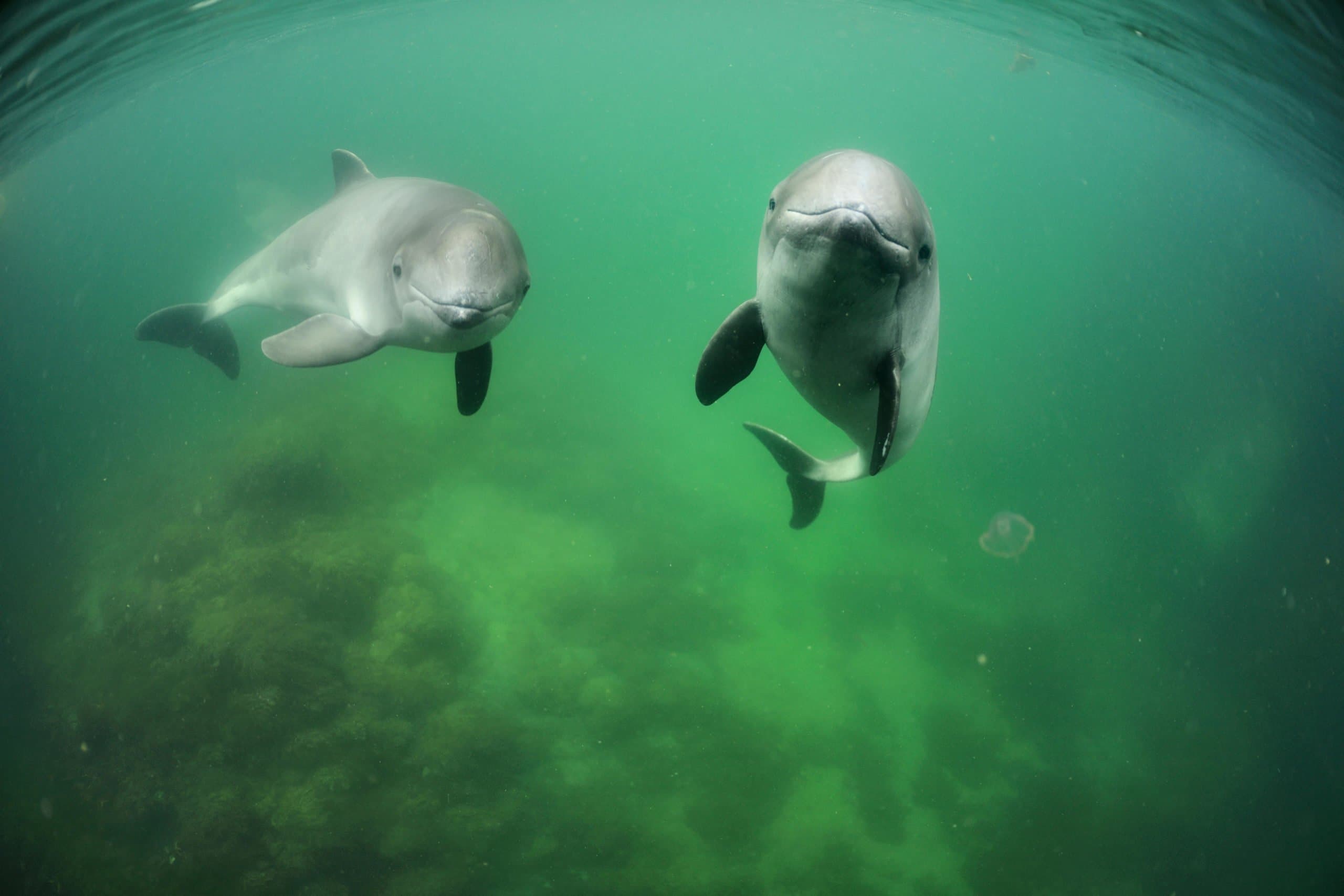
Harbour porpoise (Phocoena Phocoena). Photo: naturepl.com / SCOTLAND: The Big Picture / WWF
Contact: Stina Nyström
The harbour porpoise is the only whale species that lives in the Baltic Sea region year-round. There are three genetically and morphologically different populations: one in the North Sea, one in the Belt Sea, and one in the Baltic proper. The latter is listed by IUCN and HELCOM as ‘critically endangered’. Today there are only about 500 individuals left.
Threats
The main threats to the porpoises in the Baltic Sea are incidental catches (bycatch) in fishing gear, environmental contaminants, prey depletion and disturbance by underwater noise. While contaminants, prey depletion and noise contribute to the population failing to recover, bycatch – primarily in gillnets – is the single acute threat causing direct mortalities. The porpoises fail to detect the nets in time to avoid them, get caught and subsequently drown. Considering the small size of the population, and a very low number of reproductive females, bycatch must be reduced to an absolute minimum, ideally to zero.
Baltic harbour porpoises are also exposed to high levels of underwater noise, for example from heavy shipping traffic, seismic surveys, and construction of marine infrastructure. Since the animals are totally dependent on hearing for their survival, they are very sensitive to underwater noise which prevents them from locating prey and hearing each other. It also scares them away from critical habitats, for example areas where they breed and bring up their calves.
You can learn more about the threats, their effect on Baltic harbour porpoises and suggested mitigation measures in the Jastarnia Plan – ASCOBANS Recovery Plan for Baltic Harbour Porpoises.
How can we save our Baltic porpoise?
We need more and effectively managed marine protected areas (MPAs) where porpoises can live with no, or reduced, harmful impacts from human activities. In Swedish waters, a large Natura 2000 area was designated in 2016 to protect the harbour porpoise in the Baltic proper. However, so far, it is just a ‘paper park’ with no management plan and no protection measures in place.
To support the establishment of effective management measures in MPAs for small cetaceans, WWF, Coalition Clean Baltic, the Finnish Ministry of the Environment and ASCOBANS (the Agreement on the Conservation of Small Cetaceans of the Baltic, North East Atlantic, Irish and North Seas) had planned a regional workshop for April, which has been postponed to later this year, due to Covid-19. The aim is to convene experts to discuss and make recommendations on criteria and clear options for well-formulated conservation objectives, as well as to create a toolbox of ambitious and innovative practical conservation measures for small cetacean MPAs.
International Day of the Baltic Harbour Porpoise – 17 May
17 May was the annual International Day of the Baltic Harbour Porpoise!
In 2002, ASCOBANS* designated the third Sunday in May of each year as the International Day of the Baltic Harbour Porpoise, to raise awareness on the critical conservation status of the only cetacean species population native to the Baltic Sea. It aims to promote public support through various events and exhibitions at museums and scientific institutions around the Baltic Sea. The day offers an opportunity to highlight the critical status of Baltic harbour porpoise population and the threats to its survival.
*ASCOBANS – the Agreement on the Conservation of Small Cetaceans of the Baltic, North East Atlantic, Irish and North Seas – is a regional agreement on the protection of small cetaceans under UNEP Convention on Migratory Species (CMS). The ASCOBANS Secretariat, located in Bonn, acts as the coordinating body.
This article is part of the WWF Baltic Newsletter – May 2020


