
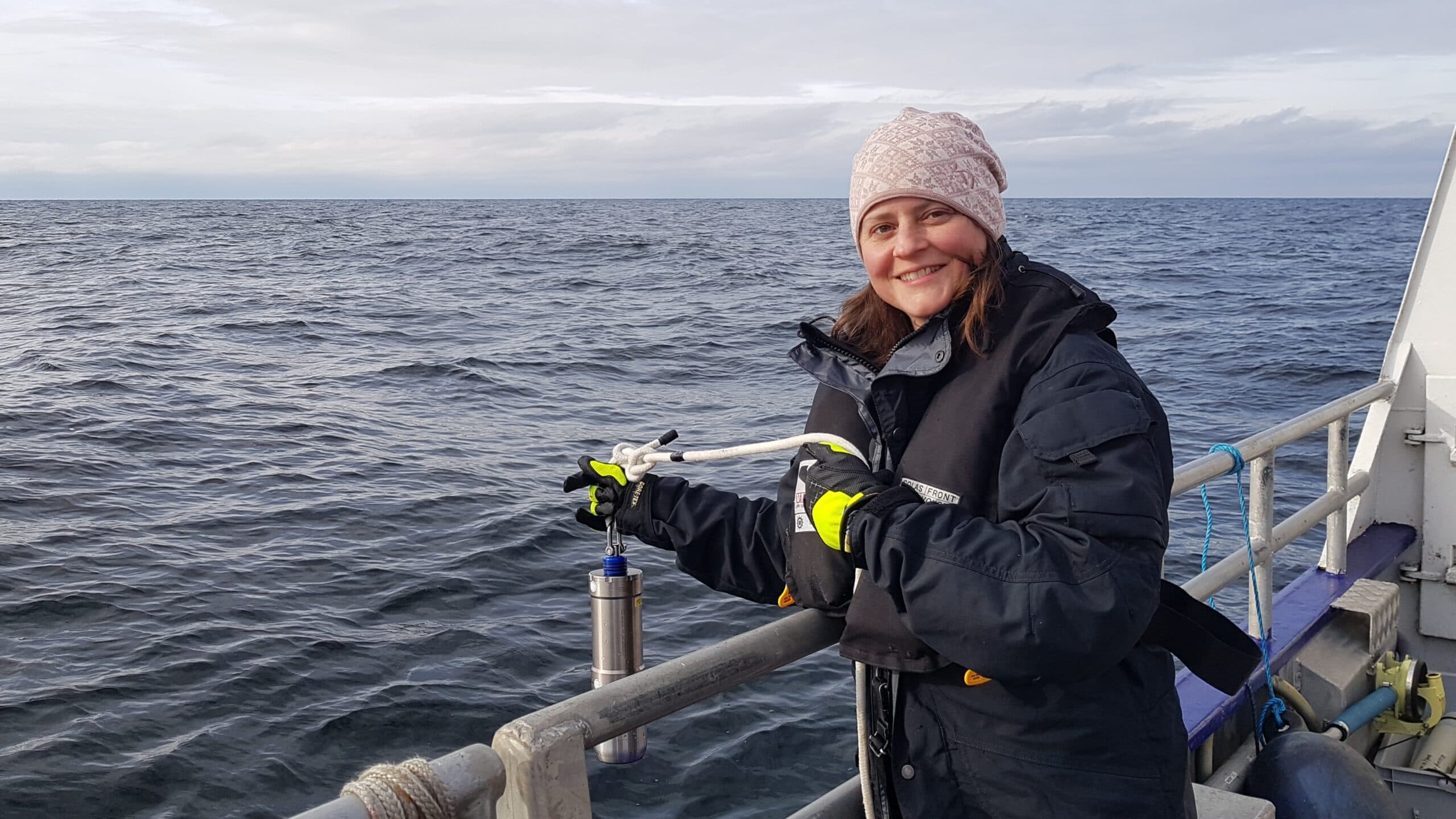
Researcher Emilia Lalander out at sea, ready to deploy a Sound Velocity Profiler (SVP).
Photo Julia Carlström
Contact: Stina Nyström
It is well established that underwater noise has an impact on individual marine animals but the consequences at a population level are not yet fully understood. Several species such as the Baltic Sea harbour porpoise and cod are under environmental pressure. Underwater noise adds stress to these already threatened species. To take appropriate measures, managers need information on sound levels over time and at different locations. They also need to understand whether the sources of the noise are natural or anthropogenic.
In 2018, WWF Sweden and research partners launched the Postcode Lottery funded project, A living Baltic Sea. The project contributes to marine protection and effective management of key marine areas and species in the Swedish part of the Baltic Sea. One of the implementing partners, Swedish Defence Research Agency, has been collecting sound recordings for the Swedish national monitoring of underwater noise.

Figure 1. Ship traffic density for year 2018 in the Northern Midsea bank with the hydrophone locations marked out, and also the boundaries of the Natura 2000 area “Hoburgs bank and Midsjöbankarna”.
Between 2015 and 2018, the project used commercial hydrophones to analyze the movement of ships in the Northern Midsea bank off the coast of Sweden (approximately five km from a dense shipping lane (NM North)), using the Automatic Identification System (Fig 1). The data was compared with sound recordings made in a quieter location, approximately 15 km from the nearest shipping lane (NM South).
The results show ship noise to be the dominant sound source at this location, one that is always present in lower frequencies. The distance to the shipping lane affects the noise levels. For an animal with a hearing range in the lower frequencies (~100 Hz) such as cod, the ability to communicate is greatly affected in the NM north location. Higher noise levels of 10dB reduce the communication range to one third. Communication among marine mammals is less affected because they can hear higher frequencies (>1000 Hz). However, at a distance of one kilometre from the shipping lanes, research has shown that the harbour porpoise is likely to react to ship noise. On any given day, ship traffic passes within one kilometre of 39% of the marine protected area, likely creating noise levels that would be expected to impact harbour porpoises.
This article is part of the WWF Baltic Newsletter – May 2021


