
Contact: Edel Shanahan
On October 21, the European Parliament and Council shut their eyes to the converging crises of biodiversity and climate and ploughed on with updates to the Common Agricultural Policy (CAP) that had little environmental credibility. Their position results in a CAP that falls short of what was needed for a more effective, fairer, greener EU farm policy.
The co-legislators have diminished the basic environmental conditions attached to EU farm subsidies, negating the European Commission and its Green Deal. The greening of Europe’s farm policy will now largely depend on eco-schemes, a novel and untested system of incentives for farmers.
“It is terribly disheartening. Behind their glossy words, MEPs and agriculture ministers are largely perpetuating a farm policy which will throw taxpayers’ money at polluting, industrialized agriculture until at least 2027.”
Jabier Ruiz, WWF EPO Senior Policy Officer, Agriculture & Food.
Receiving around one third of the EU budget, the CAP has been a driving force behind the intensification of agriculture in the EU. It is now undergoing trialogue negotiations between the Commission, Council and Parliament. It will be crucial for the Commission to uphold the Green Deal and give clear guidance and recommendations to prevent eco-schemes from being poorly implemented or failing, as the CAP greening did in the previous CAP reform in 2013.
The Council’s position is even worse than that of the Parliament. Aside from ring-fencing 20% of CAP direct payments for eco-schemes, the Council position weakens every single environmental component of the draft CAP regulation proposed by the Commission in 2018. Most notably, Agriculture Ministers have watered down the ‘do-no-harm’ criteria – known as ‘CAP conditionality’ – to simply maintain existing weaker standards. Some of these, such as “ecological focus areas” and “crop diversification”, have a track record of failing to avoid the impacts of agriculture on nature and climate.
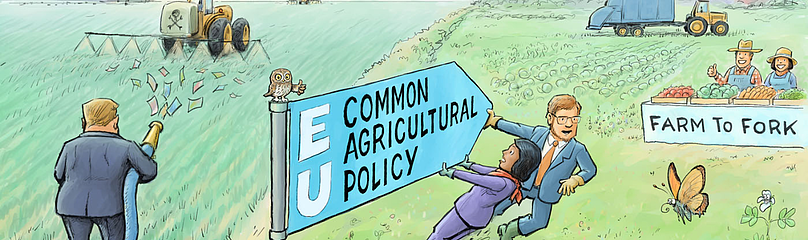
The CAP has the potential to change the fate of biodiversity and climate in the EU but so far it has failed to do so. Photo: WWF EPO
Ministers have similarly rejected the proposed increase in environmental expenditure under the CAP’s Rural Development Fund, in particular by continuing to consider Areas of Natural Constraints payments (i.e. subsidies for farmers in mountainous areas and other types of land which are more difficult to farm) as 100% green. This will reduce the funds available to support farmers through agri-environmental schemes and investments to support the transition to agro-ecological farming.
“It is terribly disheartening. Behind their glossy words, MEPs and agriculture ministers are largely perpetuating a farm policy which will throw taxpayers’ money at polluting, industrialized agriculture until at least 2027. This flies in the face of scientific warnings about loss of nature and increasing greenhouse gas emissions from destructive farming. It fails farmers and nature alike,” concluded Jabier Ruiz, WWF EPO Senior Policy Officer, Agriculture & Food.
Read the original article
This article is part of the WWF Baltic Newsletter – December 2020


