
Contact: Jenny Jyrkänkallio-Mikkola
Climate change is projected to increase the number of mild winters and levels of precipitation in Finland, posing a major threat to water protection. While 87% of Finland’s lakes and 68% of its rivers are in ‘high’ or ‘good’ ecological condition, only 13% of coastal waters qualify as ‘good’. Many of the water bodies in poorer condition are located near the coast and in many cases, eutrophication is the most significant problem (Fig.1).
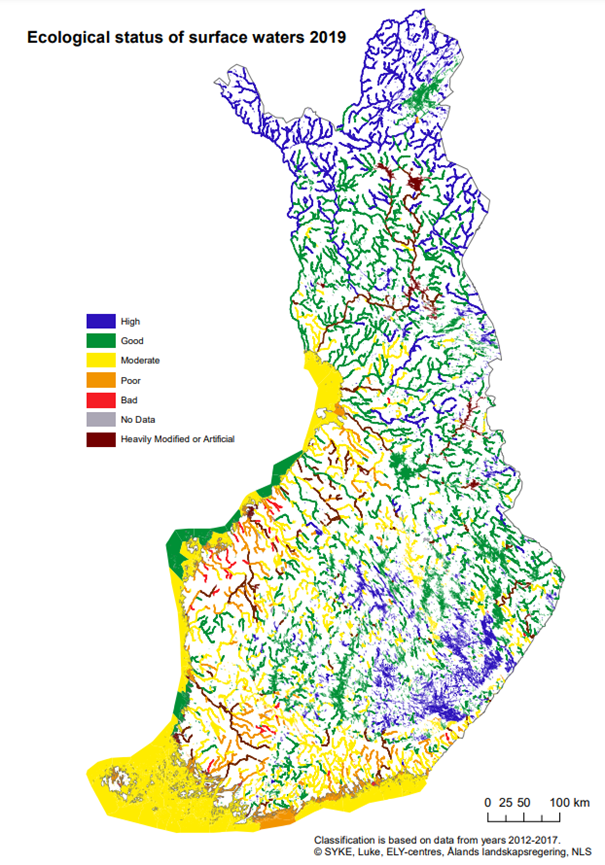
February 2020 was a daunting example of what happens during heavy winter rains when vegetation cover is low. The phosphorus load to the Archipelago Sea was ten times higher than in an average winter. The increased nutrient and sediment loads in all rivers flowing to the Baltic Sea can clearly be seen from satellite images.
Together with extensive drainage, the clearing of wetlands and mires for other land use purposes has destroyed the natural capacity of catchment areas to retain water. Hence, there is a need to restore and construct water retention sites in all catchment areas. The third management cycle of the river basin management plans for 2022– 2027 is now under public consultation and the challenge is how to inspire landowners to take a lead on this restoration and construction on a voluntary basis.
The work requires additional funding, coordination, planning and advocacy with environmental authorities and municipalities – tasks for which few landowners have the time or motivation. Regional water protection projects can address some of these shortcomings by, for example, constructing water retention sites.
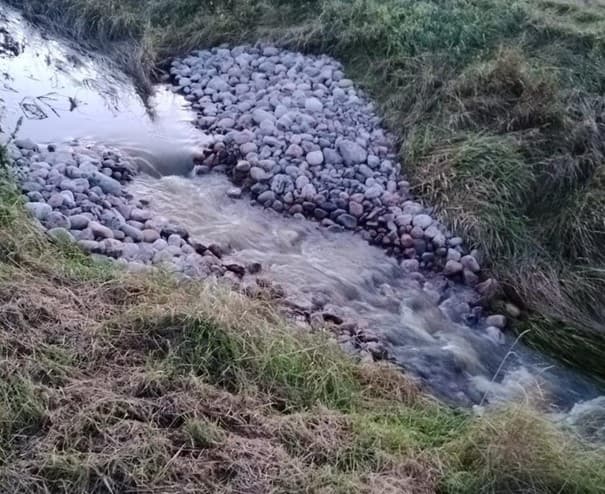
WWF Finland has led two such projects (Project Vesiensuojelu 4K and Project VALUTA) in western Uusimaa on three catchment areas, over time building water retention sites such as wetlands, two-stage-ditches and bottom weirs. These examples have inspired new landowners to participate.
Coordination and facilitation must be ongoing and continuous in order to increase the number of voluntary water protection measures. WWF Finland’s projects fund, plan, and construct the sites – activities the landowners were unlikely to undertake themselves. Although it may take some for landowners to decide to take action, when they do the financial and coordination assistance is warmly welcomed.
This article is part of the WWF Baltic Newsletter – May 2021

